


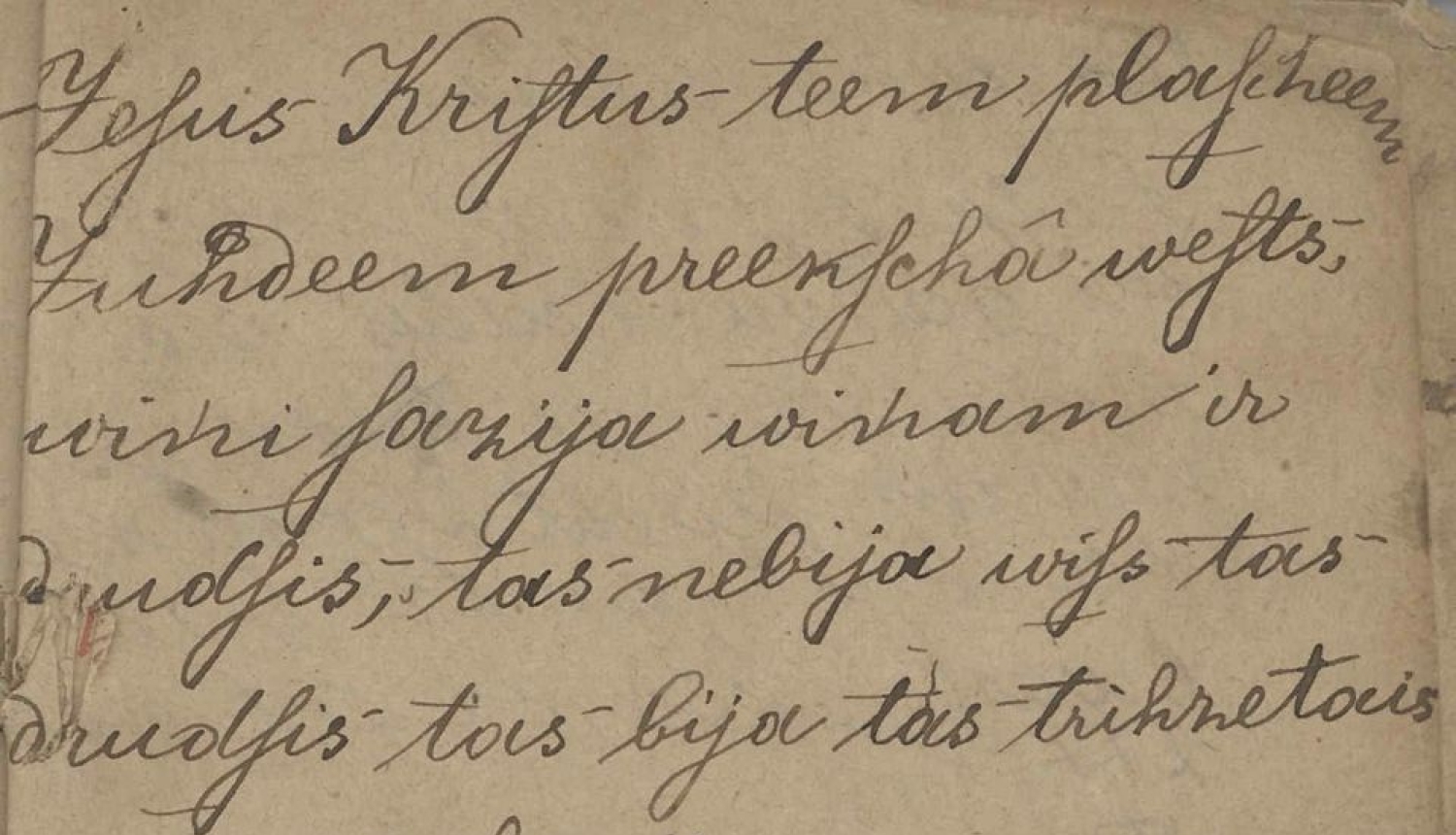
Letters, folklore records, inventory books and early printed texts are helping artificial intelligence learn the diversity of historical texts in Latvian and Russian
Imagine a letter written many decades ago: delicate or hurried handwriting, faded ink, paper folds and a smudge where a word should be. Such a document is more than just text. It holds a person’s voice, the mood of an era and experiences that might otherwise go unnoticed. For a human, deciphering historical handwriting can take considerable time and patience. In the future, artificial intelligence could make this work easier, but only if it is trained on sufficiently diverse, carefully prepared examples.
This is exactly the purpose of the Interreg Central Baltic Programme project ArchXAI (2025–2028). The national archives of Latvia, Estonia and Finland, together with South-Eastern Finland University of Applied Sciences (Xamk), are developing artificial intelligence solutions for handwritten and printed text recognition, known as HTR and OCR, in Latvian, Estonian, Finnish and Russian. The project is not technological experimentation for its own sake. At its heart is the aim of making documentary heritage easier to find, read and use in research, education and public learning.
The National Archives of Latvia brought four memory institutions into the project collaboration: the association “Latvians Abroad – Museum and Research Centre”, the Archives of Latvian Folklore of the Institute of Literature, Folklore and Art of the University of Latvia, the Latvian War Museum and the National Library of Latvia. Each institution contributed a different body of documents, its own professional experience and its own perspective on why recognizing historical texts matters. This diversity enriches the project’s training data and at the same time helps test whether the emerging solution will be able to handle real, complex cultural heritage sources.
Not Just Data, but People’s Stories
For an artificial intelligence model, every submitted image and its transcription is a training example. For memory institutions, it is a specific historical source with its own story of origin, content and significance. The partners’ involvement therefore builds a bridge between technology and the living context of a document. It allows the developers to work not with abstract texts, but with letters, folklore records, registration documents and printed sources that reflect different times, people, languages and writing practices.
“Latvians Abroad”: The Voice of the Diaspora Preserved in Handwriting
The association “Latvians Abroad – Museum and Research Centre” was founded in 2007 and is the only museum in the world whose main mission is to collect testimonies, objects, photographs and stories about Latvian emigration and life in the diaspora. In the museum’s collection, letters, postcards and diaries preserve personal experiences, relationships and ties with Latvia across national borders and generations.
For the ArchXAI project, the museum provided images of 35 letters written in Latvian from various periods and countries. These materials offer the model a range of different handwriting, paper, ink quality and writing styles. For the museum, taking part in the project comes with the hope that the new tool will in future help decipher letters, postcards, diaries and other handwritten materials more quickly, making research easier and helping to open the collection.
“We expect the newly developed artificial intelligence tool to help decipher handwriting and, in this way, improve the museum’s work, especially when dealing with letters, postcards, diaries and other handwritten materials.” Representative of the “Latvians Abroad – Museum and Research Centre” |
Here, the benefit of technology is especially human: handwriting that is hard to read can once again become a voice that can be heard. Every line read more accurately can reveal a family’s experience, a migration route or a detail of everyday life that adds to the shared story of the Latvian diaspora.
Archives of Latvian Folklore: Community Effort and the Possibilities of New Technologies
Since 1924, the Archives of Latvian Folklore have been documenting, archiving, researching and publishing the intangible cultural heritage of Latvians and Latvia’s national minorities. A significant part of the collection consists of manuscripts, including 19th-century folklore collections. Since 2014, while building the digital archive garamantas.lv (https://garamantas.lv/?lang=en), all of the archives’ historical collections have been digitized, and approximately 1.02 million manuscript images are publicly available.
Making this volume accessible has already been closely linked to public participation. Volunteers have transcribed nearly 325,000 manuscript files, almost a third of the archive, devoting more than 95,000 hours to this work. The archives regard public involvement in transcription as a deliberate and valuable choice, while also keeping track of developments in handwritten text recognition and digital archiving technologies.
For the project, the Archives of Latvian Folklore provided a transcribed and segmented set of handwritten material, including 25 images in Latvian and three in Russian, from the records of folklore collectors of the 1920s and 1930s. In turn, within the project, an equivalent number of pages from the manuscript collection of Kārlis Bukums, a folklore collector from the Valmiera region, will be recognized for the archives’ needs. The participation of the Institute of Literature, Folklore and Art in the ArchXAI steering group allows it to follow the project’s technological solutions and contribute to training the Latvian handwriting recognition model.
“The most important benefit is the opportunity to assess the potential of new technologies in working with large collections of historical manuscripts and, possibly, to add them to the archives’ range of digital tools in the future.” Representative of the Archives of Latvian Folklore |
The experience of the Archives of Latvian Folklore shows that artificial intelligence is not a substitute for public participation. It can become a complementary tool that helps handle large volumes of documents, while human knowledge and interest remain essential for understanding and verifying texts and for revealing their cultural context.
Latvian War Museum: New Experience in Working with Registration Records
The origins of the Latvian War Museum date back to the First World War. Although visitors often associate the museum with its collections of weapons and uniforms, a large part of its holdings consists of documentary heritage. During the Soviet occupation, a considerable amount of collection material and registration documentation in Russian was accumulated, and many of these materials are still awaiting review and full description.
For the ArchXAI project, the museum provided 42 images of inventory books: 28 in Latvian and 14 in Russian. These samples are important for the project because they represent a type of source that is essential in the everyday work of memory institutions, while also adding to the diversity of languages and handwriting. For the museum’s staff, the collaboration provided an opportunity to gain experience with a new digital tool - Transkribus and to learn hands-on how to segment and transcribe texts.
“We have gained valuable experience.” Representative of the Latvian War Museum |
This benefit confirms that the project is delivering results already during its development. Partners are not only handing over transcriptions but also building their professional skills and gaining a better understanding of how the preparation of historical documents affects the training of artificial intelligence. The quality of the project’s results thus grows together with people’s experience and the exchange of knowledge.
National Library of Latvia: Complex Sources Need Reusable Solutions
Since the early 2000s, the National Library of Latvia has been carrying out large-scale digitization of cultural heritage and developing the Digital Library and periodika.lv (https://periodika.lndb.lv/). Alongside printed works, the library’s collection holds manuscripts, letters, early printed books and other materials whose digitization and text recognition require specialized methods.
For the project, the National Library of Latvia provided 18,000 OCR lines that help improve printed text recognition. In April of 2026, an ArchXAI workshop took place at the National Library of Latvia, bringing together around 50 specialists from Latvia, Estonia and Finland. The library’s contribution thus combines training data, experience in cultural heritage digitisation and a setting for professional collaboration.
“Particularly important is the project’s aim to create open and reusable models that would be available to memory institutions throughout Latvia and could be used in digitizing their collections.” Representative of the National Library of Latvia |
This aspiration extends the project’s significance beyond a single archive or a single collection. If the models are open and reusable, the experience gained during the project will be able to benefit other Latvian memory institutions too and help with cultural heritage materials that have not yet been digitized.
Diversity as a Precondition for Project Quality
The four partners’ materials differ in content, period, language and type of writing. The diaspora letters bring personal and geographically wide-ranging experience. The folklore records represent the handwriting of different collectors and an extensive body of public transcription work. The War Museum’s inventory books help in working with institutional registration documentation in Latvian and Russian. The library’s OCR lines strengthen printed text recognition.
It is precisely this variety that enriches the project’s training material. An artificial intelligence solution becomes more valuable not because it sees many identical examples, but because it is given the chance to learn from the real diversity of documentary heritage. The partners’ professional knowledge also helps to understand where technology can offer practical support and where human verification, interpretation and responsibility are still needed.
The Human Value of Collaboration
The ArchXAI collaboration brings together institutions whose collections and daily tasks differ, but which share a common desire to make cultural heritage more accessible. The partners’ involvement gives the project more than images and transcriptions. It brings trust, curiosity, professional responsibility and a willingness to try new ways of working.
This collaboration also creates an emotional closeness to the documents. Behind every unit of training data there is a letter, a recorded song, a museum collection entry or a page of a printed work. The awareness that technological progress can help read and find these sources better gives the project a human purpose. It is not only a question of processing speed. It is a question of bringing back into circulation words and testimonies that might otherwise remain hard to access.
What’s Next?
Artificial intelligence in archives does not begin with an algorithm. It begins with people who are willing to share their collections, time, knowledge and experience. The contributions of “Latvians Abroad”, the Archives of Latvian Folklore, the Latvian War Museum and the National Library of Latvia are helping to build a solution grounded in real documents and in the needs of memory institutions.
The ArchXAI project runs from June 2025 to May 2028. Its aim is to make cross-border archival heritage more accessible to historians, genealogists, students and anyone interested. The value of the work ahead will depend both on technological development and on how accurately the project manages to capture the experience of users and memory institutions.
Get Involved in Shaping ArchXAI The experience of archive users will help identify the needs and practical uses of the emerging solution. The survey is available in Latvian, Estonian, Finnish and English. |
Thank you to all our partners for their contribution, trust and willingness to work together towards a more accessible documentary heritage.